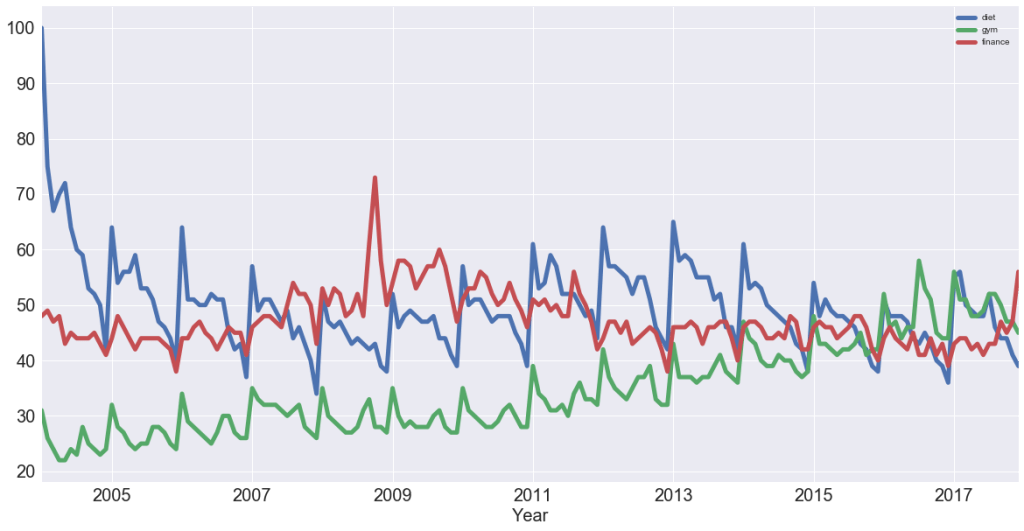
Break for Time Series Components (BFTSC) and Group for Time Series Components (GFTSC)
The main objective of this study is to evaluate BFTSC (break for time series components) and GFTSC (group for time series components) identification of time series components. The weaknesses of BFAST (Break for Additive Seasonal and Trend) were corrected by the extension of BFAST to BFTSC which resulted into creation of two new technique named Break for Time Series Components (BFTSC) and Group for Time Series Components (GFTSC).BFTSC is created to capture the trend, seasonal, cyclical and irregular components as a combined image and to present them in a single plot. Group for Time Series Components (GFTSC) is designed to capture all the time series components on a different individual time plot. BFAST only identifies trend and seasonal components while considering all others as random. BFTSC and GFTSC is created to include cyclical and irregular components and this was included in the methodology. Read more at http://www.jardcs.org/special-issue.php. Google scholar.
Reliability Measures of Academic Performance
One of the factors that determines the class of the degree that a student has after academic programme is the first year result. This is a general claim and was investigated in this study. Data used for the investigation were the results of graduating students in the Faculty of Science in University of Ilorin, Nigeria in 2012. The data were analysed with R GUI, although a program was written for the tau statistic since it is not available in it. The aim was to study the proportion of students that will graduate with the classification of degree they started with. The objectives are to predict future occurrences for students and study the trend of performance for students. Agreement index of tau statistic was used to determine agreement level of first year results with final year results. Department of Physics had the lowest agreement. Even at that, it was significantly high.
Simulation of Data to Contain the Four Time Series Components in Univariate Forecasting
The main objective of this study is to describe the simulation of data that contain the four time series components in univariate forecasting. Time series data occur in a mixture of all the four time series components in its natural form (trend component, seasonal components, cyclical components, irregular components). Simulated data are generated in mixture of all the components before separating each components to its individual group. Statistical techniques is being required in the traditional system to separate those components into its various individual components to archive smooth forecast.
Autoregressive Model for Cocoa Production in Nigeria
In this study, the trend and stationarity of cocoa production was examined to check whether itsatisfied the statistical assumptions before the autoregressive model of order two after firstdifference was selected. The plot of the cocoa production was not stationary in mean, as the levelchanges over time. Phillips-Perron Unit Root Test was used to check the claim and equally showedthat cocoa production was not stationary. There was very little evidence for non-zeroautocorrelations in the forecasts errors at lags 1-20.The forecast errors seems to have roughly constant variance over time. The histogram of the time series showed that the forecast errors were roughly normally distributed and the mean seems to be close to zero. Therefore, it was plausible that the forecast errors were normally distributed with mean zero and constant variance.
Follow My Blog
Get new content delivered directly to your inbox.
 Ajare The Statistician